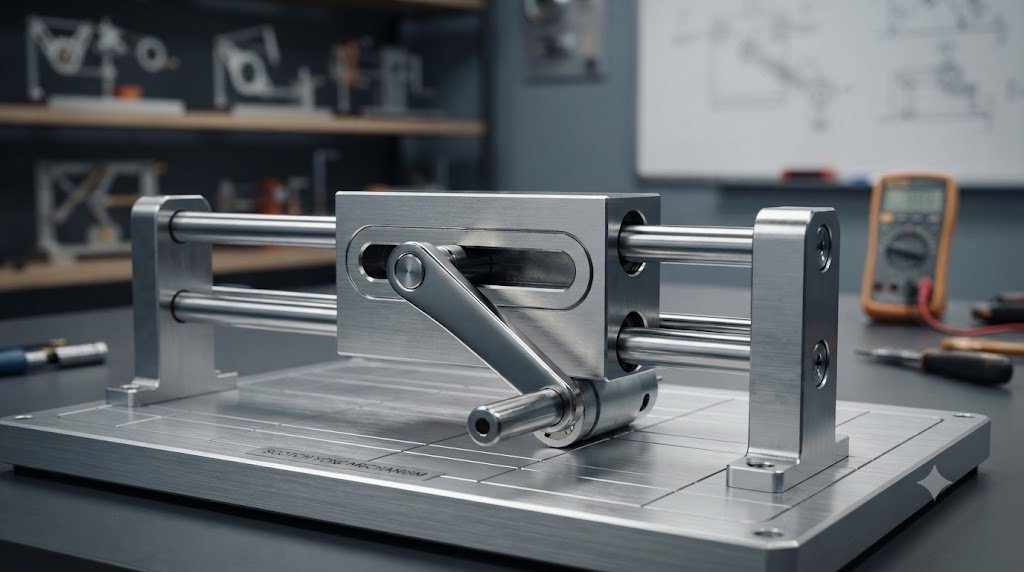
Welcome to MechanismLab Online (accessible at https://mechanismlab.online/), an independent digital engineering portal, research archive, and pedagogical open-access platform committed to excellence in classical kinematics, precision gear design, tribology and bearing mechanics, compliant springs, foundational lever systems, and dynamic mechanical motion control. Established to serve as a rigorous, mathematically sound bridge between classical machine theory and contemporary mechatronic automation, MechanismLab Online provides engineering scholars, CAD designers, roboticists, machinists, and industrial practitioners with comprehensive technical monographs, empirical formulations, and design methodologies.
Editorial Leadership & Engineering Authority
MechanismLab Online is curated and led by Dr. Evelyn Vance, a veteran Mechanical Design Engineer and Kinematics Researcher with eighteen years of continuous practice across heavy machinery design, aerospace actuator mechanisms, and high-precision micro-motion assemblies. Having earned her doctorate in Mechanical Engineering with a doctoral dissertation focusing on non-linear stiffness dynamics in compliant four-bar mechanisms, Dr. Vance has served as a senior design consultant for tier-one automotive transmission manufacturers, high-speed robotics laboratories, and precision scientific instrumentation developers.
Under Dr. Vance’s technical direction, every article, derivation, kinematic diagram, and material specification table published on MechanismLab Online undergoes exhaustive multi-tiered technical validation. Our editorial board cross-references all theoretical treatments against standardized international engineering codes—principally the American Gear Manufacturers Association (AGMA), the International Organization for Standardization (ISO), the American Bearing Manufacturers Association (ABMA), and the German Institute for Standardization (DIN) standards. We reject superficial summaries and generic overviews; our commitment is to provide actionable engineering depth that can be directly applied to physical prototypes and production machinery.
Core Research Domains & Technical Disciplines
Our open-access publication repository is structured across five primary branches of machine theory and mechanical component design:
- Precision Gear Systems: Comprehensive analyses of involute geometry, cycloidal gearing, contact ratios, spur, helical, bevel, worm, hypoid, and epicyclic planetary gear trains. We explore tooth root bending fatigue (Lewis formula and AGMA bending stress numbers), surface pitting endurance limits, backlash control, tooth crowning, profile modification, and planetary load-sharing dynamics under dynamic torsional deflection.
- Tribology & Bearing Architectures: Mathematical modeling of sliding friction, elastohydrodynamic lubrication (EHL), Stribeck curves, deep groove radial ball bearings, cylindrical and tapered roller bearings, fluid film hydrodynamic journal bearings, and ISO 281 bearing fatigue life ($L_{10}$ and $L_{10m}$) calculations incorporating advanced contamination and lubricant viscosity ratios.
- Spring Mechanics & Energy Storage: Linear and non-linear elastic deformation, Wahl stress correction factors in helical compression springs, Belleville disc spring stacks, constant-force clock springs, torsion bars, wave springs, and high-cycle dynamic fatigue mitigation through shot peening, hot presetting, and corrosion barrier coatings.
- Lever Dynamics & Linkage Kinematics: Mechanical advantage formulations, class 1, 2, and 3 lever systems, virtual work principles, toggle mechanisms, compound linkage geometry, structural fulcrum pin shear stresses, Euler column buckling of connecting struts, and kinematic transmission angle optimization.
- Complex Mechanical Motion & Synthesis: Planar kinematic synthesis, Freudenstein’s equation for four-bar linkages, cam and follower displacement-velocity-acceleration-jerk curves, Geneva intermittent indexing drives, Chebyshev straight-line approximations, and scotch-yoke harmonic oscillators.
Pedagogical Methodology and First-Principles Philosophy
Machine design is both an analytical science and a physical craft. When an engineering mechanism fails in the field, the root cause is rarely an inability to run finite element analysis (FEA) software; rather, it is almost invariably a failure to anticipate fundamental physical behaviors: thermal expansion binding in closely fitted journal bearings, unexpected resonant vibration exciting a spring’s natural frequency, improper contact ratio inducing gear tooth tip interference, or unintended singularities in a mechanical linkage. Our monographs emphasize first-principles thinking:
- First-Principles Derivations: Every fundamental equation—from Euler-Bernoulli beam deflections applied to lever arms to Hertzian contact stress tensors on gear teeth—is derived with clear physical context so engineers understand underlying assumptions and boundary limits.
- Empirical Manufacturing Context: Real-world machines are not made of idealized mathematical lines. We integrate manufacturing tolerances (ISO fit classes H7/p6, g6, etc.), surface finish roughness parameters ($Ra$, $Rz$), material hardness conversions (Rockwell HRC vs. Brinell HB), and heat treatment case-hardening depths (carburizing, nitriding, induction hardening).
- Dynamic Failure Mode Diagnostics: We investigate real-world failure modes including fretting corrosion, galling, adhesive wear, sub-surface shear fatigue flaking, tooth root cracking, and mechanical buckling, offering prescriptive mitigation strategies.
Bridging Classical Kinematics with Modern Mechatronics
In the contemporary industrial landscape, mechanical mechanisms are increasingly integrated with electric servomotors, digital encoders, and computerized motion controllers. However, high-performance servomotors cannot overcome poorly engineered mechanical linkages. High mechanical backlash, structural compliance, non-linear kinematic transmission angles, and excessive rotating inertia degrade control loop bandwidth and induce destructive hunting oscillations in closed-loop servo systems.
At MechanismLab Online, our research monographs specifically address this electromechanical interface. We show engineers how to size gear ratios for optimum inertia matching ($J_L / J_M = 1.0$), how to preload bearings to eliminate servo hunting, and how to utilize compliant spring mechanisms to absorb shock loads and protect high-resolution optical encoders. By uniting classical mechanics with digital controls, we empower designers to construct robust, high-bandwidth automated systems.
Material Science, Heat Treatment and Tribological Metallurgy
Mechanical components endure extreme multi-axial stress fields and surface contact pressures exceeding 2,000 MPa. Consequently, machine design cannot be divorced from physical metallurgy. Our technical guides devote extensive analysis to alloy steel selection (AISI 4140, 4340, 8620, 52100), case hardening techniques (carburizing, carbonitriding, plasma nitriding), and cryogenic grain stabilization treatments.
We explore how retained austenite transforms into brittle martensite under dynamic cyclic impact, how shot peening induces compressive residual surface stresses that suppress fatigue crack initiation, and how advanced physical vapor deposition (PVD) diamond-like carbon (DLC) coatings reduce friction coefficients in dry and boundary lubrication regimes. Understanding metallurgy ensures that precision mechanism geometry survives in harsh operating environments.
Institutional Commitments, Editorial Independence & Open Standards
MechanismLab Online is maintained as an independent technical resource. We do not accept sponsored content, paid promotional vendor placements, or deceptive commercial endorsements. When computational algorithms, numerical formulas, or material alloys are cited, they are chosen solely for their technical merit, educational value, and verifiable reliability. Our operational costs are supported via transparent digital advertising networks, including Google AdSense, which are strictly segregated from our technical editorial decisions.
We welcome peer review, collaborative academic inquiries, and field data exchange from practicing engineers worldwide. Mechanical engineering thrives when ideas are tested, challenged, and refined through physical verification. Thank you for visiting MechanismLab Online, and we invite you to explore our comprehensive library of machine design monographs.